The Yoke Line: How a Shirt Detail Became a Western Signifier
A western shirt yoke is both a shaped construction seam and a visual cue. Learn how its function, placement and styling create that familiar identity.
A western shirt yoke is a shaped panel across the shoulders or chest, not merely decoration stitched onto a shirt. Its curved seam can help a garment sit and move as intended; its outline also signals a western vocabulary that has travelled well beyond workwear. To see how those two roles separate, imagine a shirt designer deciding what to keep when a practical cut becomes a recognisable look.
Say a small clothing label is preparing a cotton shirt for a shop that wants western character without a full rodeo costume. The designer begins with a plain pattern, then considers a back yoke, a front yoke, pointed panel edges and contrast stitching. Each choice changes construction, appearance, or both. The useful question is not whether a yoke is authentic in the abstract, but what its line is doing on this particular shirt.
What does a yoke do in a shirt?
A yoke is a shaped piece of fabric joined to the shirt body along a seam. On a western shirt it commonly crosses the upper back, and may also appear across the front. The panel can provide a stable area from which the body pieces hang, while its cut helps accommodate the shoulder and upper torso.
That does not mean every yoke automatically improves fit. A shirt’s comfort depends on the whole pattern: shoulder width, armhole shape, sleeve setting, fabric and ease all matter. The yoke is one part of that arrangement. It can also make construction easier to organise, since the body can be divided and joined at a clear seam rather than treated as one uninterrupted expanse.
The seam itself is a practical boundary. It can hold layers together and provide a place for controlled shaping, while the panel’s grain and shape influence how the upper shirt lies. On some shirts the yoke is lined or doubled; on others it is a single layer. Those choices affect weight and finish, but the label “yoke” alone does not tell you how substantial the construction is.
Why does the outline look western?
The western association comes from repetition and styling, not from one compulsory shape. A pointed yoke, a shallow curve or a more elaborate sweep can all appear on shirts sold as western. Paired with details such as snap fastenings, chest pockets, piping or embroidery, the seam becomes part of a recognisable visual grammar.
Once a shape is familiar, it can signal a category even when it no longer carries the same practical purpose. A pointed line across the shoulders is easy to notice from a distance; contrast thread makes it more legible still. The same panel in matching fabric and quiet stitching may read as ordinary tailoring. Like a frame around a picture, the seam changes how the surface is read without changing the cloth beneath it.
Western shirts have also circulated through settings where their original working context is not required. Retail fashion, performance dress and everyday wardrobes have borrowed the yoke as a shorthand for the look. That borrowing can leave the construction intact, simplify it, or imitate it with decorative stitching. The visual cue survives because it is immediately readable, not because every wearer needs the same garment for the same task.
How should the designer choose the line?
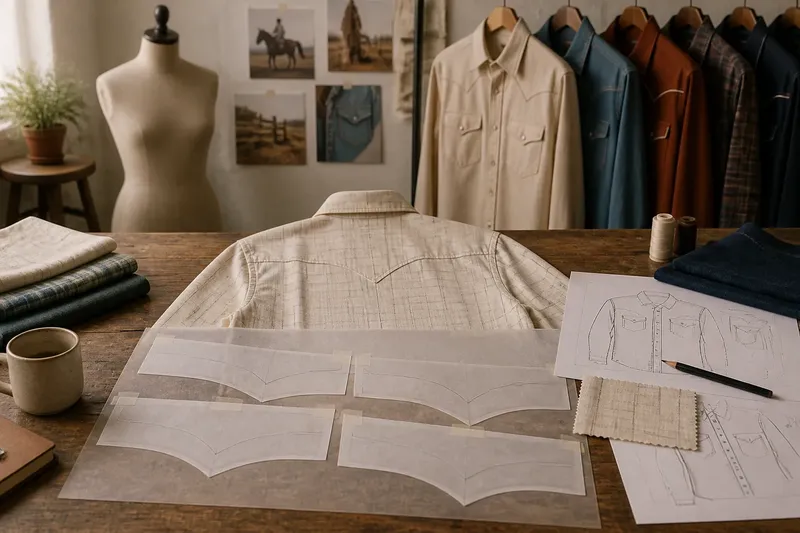
For the imagined label, the designer lays tracing paper over the back pattern and tests three outlines: a shallow arc, a pointed centre and a broad double curve. The aim is not to declare one historically correct. It is to see how each line relates to the shirt’s intended cut and the amount of visual emphasis the shop expects.
The shallow arc keeps attention on the fabric and overall silhouette. A point draws the eye towards the centre back and makes a stronger western cue. A double curve adds complexity, but can compete with a checked cloth or prominent pockets. The designer chooses a modest point, then repeats a related angle on the front yoke so the shirt feels composed rather than assembled from separate signals.
Next comes material and finish. A yoke cut from the same cotton as the body reads as part of the garment; a contrasting panel announces itself. Topstitching can clarify the seam, while embroidery turns it into a focal area. The designer uses matching thread and a small amount of visible stitching, because the sample fabric already has a busy check. This keeps the yoke discernible without asking it to compete with every other detail.
Placement matters as much as outline. If a seam sits awkwardly against the shoulder or pocket, the design can look accidental. The designer checks the pattern pieces together on a table, aligning the yoke edge with the shoulder seam and pocket position before committing to the sample. This is a design review, not a substitute for fitting the finished shirt on its intended wearer.
Which yoke details change the effect?
- Back-only yoke: Keeps the front quieter while retaining a clear western cue from behind.
- Front and back yokes: Makes the construction a more prominent part of the shirt’s identity.
- Pointed edge: Creates a sharper, more emphatic outline than a shallow curve.
- Contrast fabric: Makes the panel read as a deliberate visual block, especially on a plain body.
- Matching topstitching: Defines the seam without making it the main event.
- Embroidery or piping: Adds further emphasis, so the designer should consider the pockets, checks and fastening style alongside it.
These are not rules of authenticity. They are choices with visible consequences. A plain yoke can still be shaped and well constructed; a dramatic one can be mostly a stylistic gesture. Looking closely at the seam, rather than relying on a product description, helps distinguish a panel that forms part of the shirt from stitching that only draws a similar outline.
What should you look for when buying one?
Start with the shirt’s intended use and the way it sits on your shoulders. Check that the yoke seam lies smoothly rather than pulling into ridges, and look at how the sleeves move when you raise your arms. A striking point cannot compensate for a shoulder that feels restrictive.
Then decide how much visual signal you want. A matching yoke and restrained stitching will work more quietly with other patterned clothing. Contrast panels, piping and embroidery make the shirt more assertive, and may be easier to pair with plain trousers or a simple jacket. Neither approach is inherently more genuine; the question is whether the shirt’s details suit the rest of your wardrobe.
Examine the inside as well as the outside. Look for a neat seam finish, an even join and fabric that does not bunch where the yoke meets the body. If the shirt is patterned, check whether the design has been matched across the seam where that alignment is part of the intended finish. Care and fabric suitability depend on the garment label and the maker’s instructions.
What do people ask about western shirt yokes?
Does every western shirt need a pointed yoke?
No. A western shirt can use a rounded or shallow yoke and still retain the association through its other details. The point is a strong visual choice, not a requirement.
Is a yoke only decorative?
No. It is a separate construction panel that joins to the body, though its exact contribution to fit depends on the pattern and fabric. Contrast stitching or embroidery may be decorative, but the underlying panel is part of the garment.
Can a shirt have a yoke at the front as well as the back?
Yes. Front yokes are often used alongside a back yoke, though the shape and prominence vary. Together they can make the construction language more noticeable across the whole shirt.
How can I tell whether a yoke is a real panel?
Inspect the inside seam and the way the fabric pieces meet. A separate panel will have a joined seam; a printed or decorative line may imitate the outline without dividing the shirt body.
What did the design decision settle?
In the imagined shirt, the modest pointed yoke gives the cotton design a western reference while leaving the fabric and pockets room to speak. The designer has not made the shirt more useful simply by making the seam visible. Rather, a construction detail now carries two jobs: organising the upper garment and shaping the impression it gives.
That double role is why the yoke remains legible in settings far removed from practical workwear. If you are choosing a western shirt, look first at how the panel is cut and joined, then at how strongly its outline is announced. The line may be a quiet piece of tailoring or the shirt’s loudest signal; either way, its effect starts with the same seam.