Rawhide, Latigo and Suede: How to Tell Three Leather Finishes Apart
Rawhide, latigo and suede look and behave differently. Learn what to inspect so you can identify each finish and choose the right material for its use.
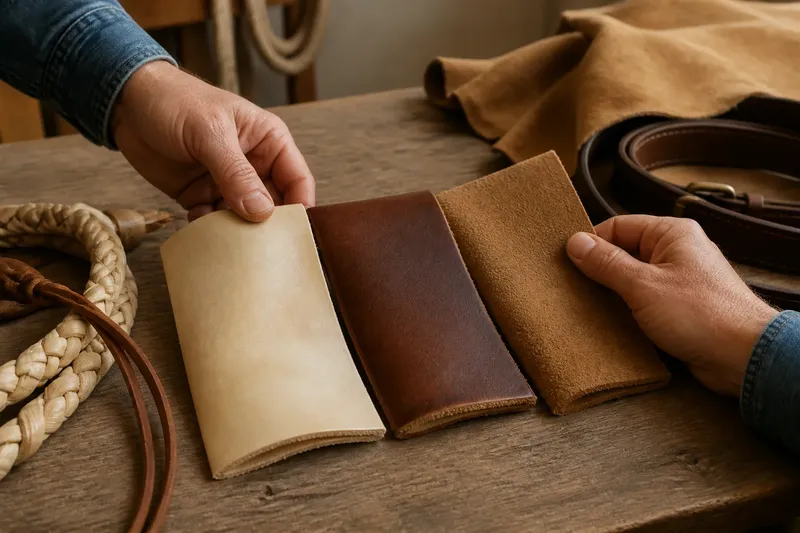
Rawhide, latigo and suede have distinct surfaces, and a close look at the edge and grain usually tells you which one you are handling. To identify rawhide, latigo and suede, begin with the visible texture, then consider flexibility and the object’s likely use; do not treat the names as interchangeable labels for brown leather.
What should you inspect first?
Start with the surface in good, even light. Turn the piece so the light falls across it rather than straight down: texture and sheen become easier to read. If you have a loose sample, look at both sides and the cut edge. On a finished object, use only areas you can see without bending, scraping or wetting it.
Check three things in order:
- Surface fibres: Is there a fuzzy nap, a smooth grain, or a hard, nearly hairless face?
- Flex: Does the material fold readily, bend with some resistance, or hold a stiff shape?
- Edge and reverse: Does the cut edge look dense and uniform, or can you see a distinct grain side and a fibrous underside?
These are clues, not a laboratory identification. Dye, polishing, wear and construction can alter the appearance. A dark colour alone tells you very little; leather is quite capable of wearing a convincing disguise.
How does rawhide look and feel?
Rawhide is animal hide that has been prepared without the tanning process used to make ordinary leather. It is commonly scraped clean and dried, leaving a firm material with little give. Its surface may be smooth, translucent, pale or marked by the hide’s natural variation, depending on preparation and finish. It does not usually have suede’s soft, directional nap or latigo’s supple, finished grain.
In Western tack and gear, rawhide is often shaped or braided for items such as bosals, reins and decorative coverings. Its stiffness is part of its character: it can hold a formed shape and take a crisp braid. A dry rawhide surface may look almost bone-like beside flexible leather. If a piece seems unusually rigid, that is useful evidence, but not enough by itself to settle the identification.
Look closely for a clean, compact surface rather than a layer of loose fibres. The reverse may be less polished and more uneven. Rawhide can be dyed or otherwise finished, so colour is a poor guide. On a finished piece, also consider how it is built: a braided item may combine rawhide strands with other materials, and the visible braid does not identify every component.
What distinguishes latigo from other leather?
Latigo is a tanned leather commonly associated with tack, straps and other gear that needs to bend while retaining body. Its surface is generally smooth, with a visible grain rather than a raised nap. Depending on its finish, it may have a modest sheen and a colour that runs through more than a thin surface coating.
Compared with rawhide, latigo normally feels more pliable and leather-like, not rigid and boardy. Compared with suede, it has no soft, brushed face. It can still be substantial, and the edges may show a dense, solid cross-section. A smooth finish does not automatically mean latigo, however: many kinds of tanned leather share that appearance.
On a strap or rein, inspect a hidden section of the surface and the edge. A supple strap with a smooth grain and a compact edge is consistent with latigo, but the maker’s description is the stronger clue when the material’s identity matters. Some pieces are lined, coated or assembled from more than one leather, which can confuse a glance at the outside.
How can you recognise suede?
Suede is identified by its napped surface: short, soft fibres give it a brushed, velvety appearance. Run a clean fingertip lightly over a discreet area. The nap may shift direction, changing the shade or leaving a temporary track. That visible change is unlike the hard, compact face of rawhide or the smooth grain of latigo.
Suede is made from the flesh side of a hide or from a split, depending on the product. Its reverse may therefore look different from its face, and the cut edge can reveal a fibrous structure. It is generally softer to the touch than the other two materials, though thickness and backing affect how readily it bends.
A fuzzy surface is not conclusive on its own. Some leather has been buffed, and synthetic materials can imitate suede. Look for the combination of nap, edge and reverse rather than relying on colour or softness alone. If the distinction affects a purchase or repair, ask the seller or maker to name the material and its construction.
Which details answer common identification questions?
Can colour tell me which material I have?
No. Rawhide, latigo and suede can all be dyed, and natural shades vary between pieces. Use surface texture and flexibility first, then check the product description if the exact material matters.
Is every fuzzy leather suede?
No. A nap suggests suede, but buffed grain leather and synthetic substitutes can look similar. Check the edge and reverse, and avoid calling a material by touch alone.
Can rawhide bend?
It can flex in some forms, particularly when shaped or braided, but it is generally firmer than latigo. Compare the piece gently with a known leather sample rather than forcing a bend in a finished item.
Can latigo have a dull surface?
Yes. Finish, wear and handling can leave latigo with little shine. A smooth grain and flexible body are more useful clues than gloss.
How should you make a confident comparison?
Put the materials side by side if possible, and compare like with like: a flat sample against another flat sample, not a thick rein against a thin suede panel. Look at the face under the same light, then turn each piece over and inspect an existing cut edge. Do not make a new cut simply to identify an item.
Say you find a dark strap in a tack room and are unsure what it is. The face is smooth, one edge looks dense, and the strap bends without collapsing into a fold. Those clues point more towards a tanned leather such as latigo than rawhide or suede, but they do not confirm the maker’s material claim. You note the observations and check the item description before choosing a replacement or repair material.
Think of the surface like the cover of a book: it tells you something about what is inside, but not everything. A glossy coating can obscure grain, while wear can soften a once-clear distinction. The right approach is to combine visible clues and leave room for uncertainty where construction hides the evidence.
Which material suits which kind of object?
The material’s character helps explain its familiar uses. Rawhide’s firm structure suits shaped and braided tack components. Latigo’s combination of body and flexibility makes it a common choice for straps and gear. Suede’s soft nap lends itself to clothing, linings and other applications where a brushed surface is wanted. These are broad associations, not rules about every product.
For an existing item, identify the material before applying a cleaner, conditioner or finish. Rawhide, finished leather and suede do not respond to care products in the same way. Follow the product label and the maker’s instructions; if neither is available and the item is valuable, ask a leatherworker familiar with that kind of construction rather than trying an aggressive treatment on the visible face.
Once you know what to look for, rawhide, latigo and suede are easier to separate: firmness and a compact face suggest rawhide, a smooth grain with flexible body points towards latigo, and a shifting, fibrous nap marks suede. Use those clues as a reading of the surface, not a substitute for an accurate material description when a repair or purchase depends on it.